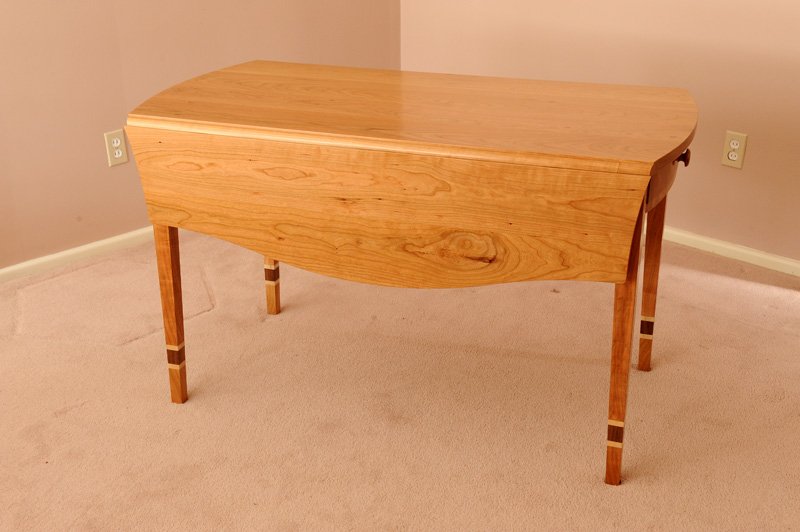
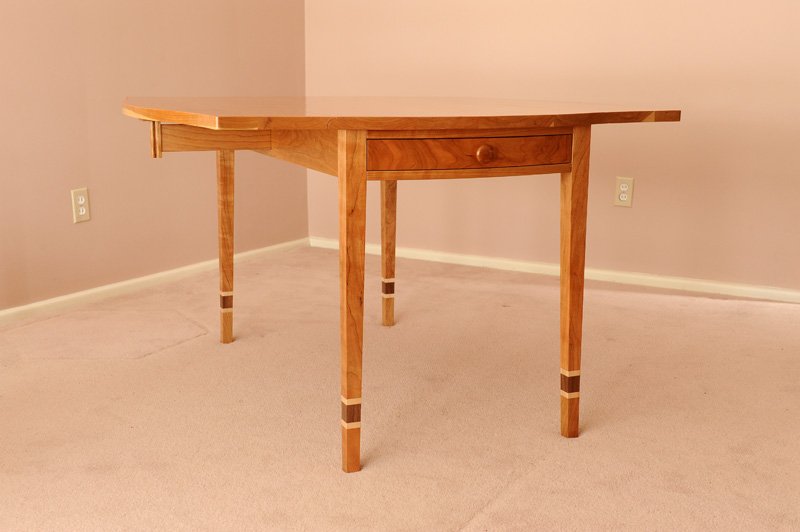
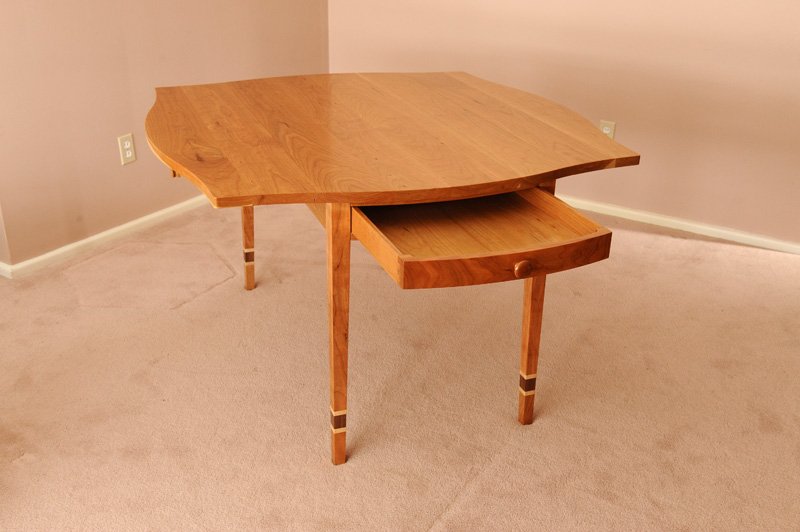
This Pembroke dining table was built as a college final project.
Made of solid cherry, legs are inlayed with maple and walnut. It has two drawers at each end and two drop leaves.
The design was found in a reference book while researching canopy bed designs. It is an 18th-century design with contemporary modifications. We decided to build this piece the first time we saw the design.
In the original design, main material was mahogany, it was beyond the budget and the color is too deep, so I followed my wife’s idea, chose cherry.
The entire table is solid wood except for the drawer bottoms, which are Baltic birch plywood with cherry veneer.
When the leaves are dropped down, table top is only 25″ by 48″, you can put it in the corner to save spaces.
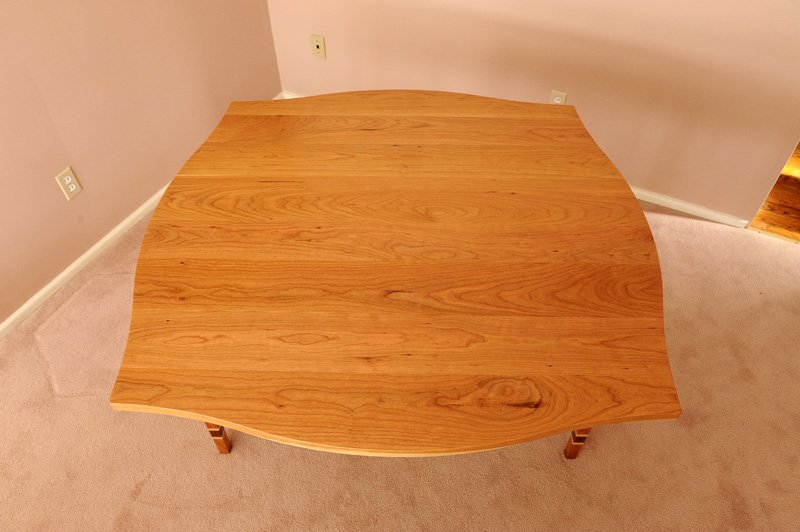
When the leaves are expanded, the table top is 48″ by 48″, a good size for 4~6 people.
The shape of the top is in between a circle and a square, calculate with AutoCAD. BTW: AutoCAD is perfect to make this kind of irregular and complex shape.
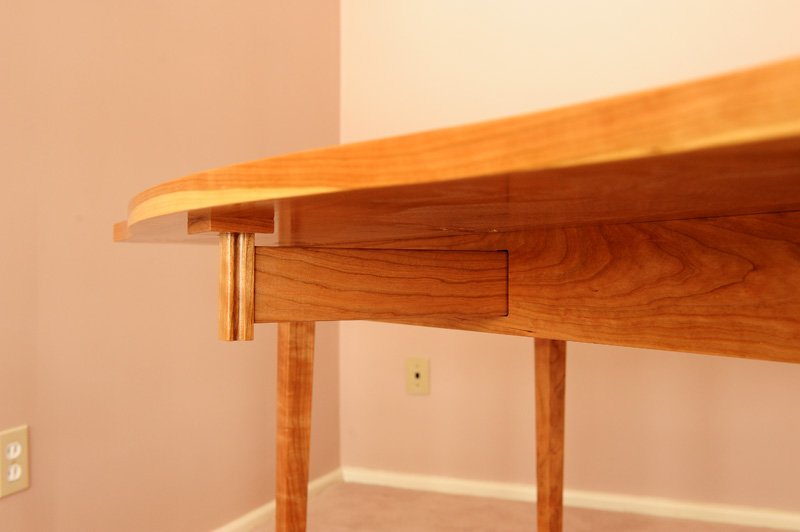
Table leaves are supported by a stick that can be collapsed into the aprons. There is a box behind apron hold and support the stick.
A stop underneath the table leaf prevents the support stick from sliding out of the table body.
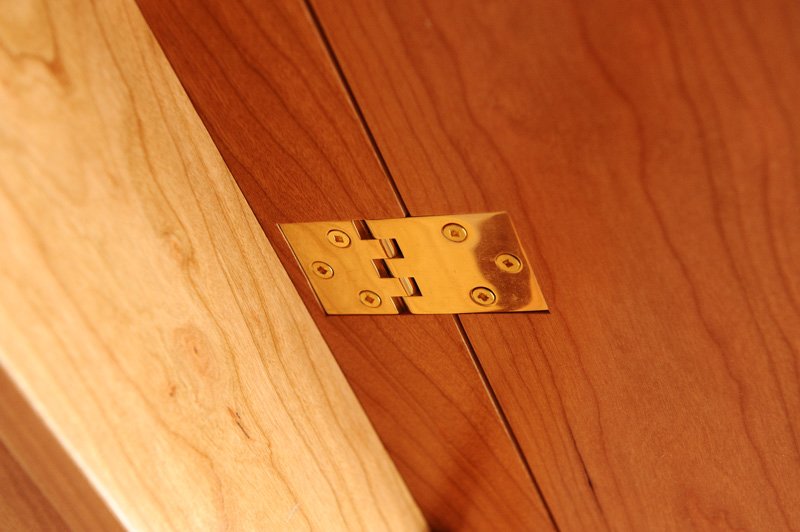
The hinges are from Lee Valley, solid brass finished with high-gloss lacquer, designed specifically for drop-leaf tables at around $40 per pair……. The result is a beautifully refined piece.
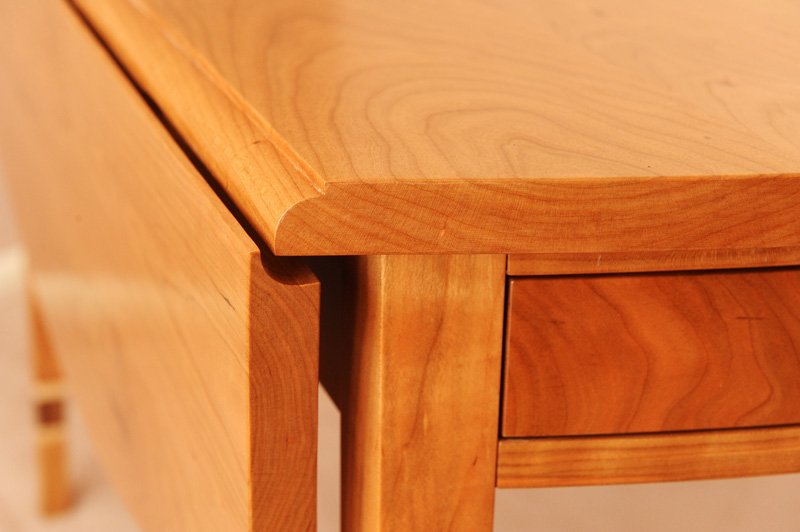
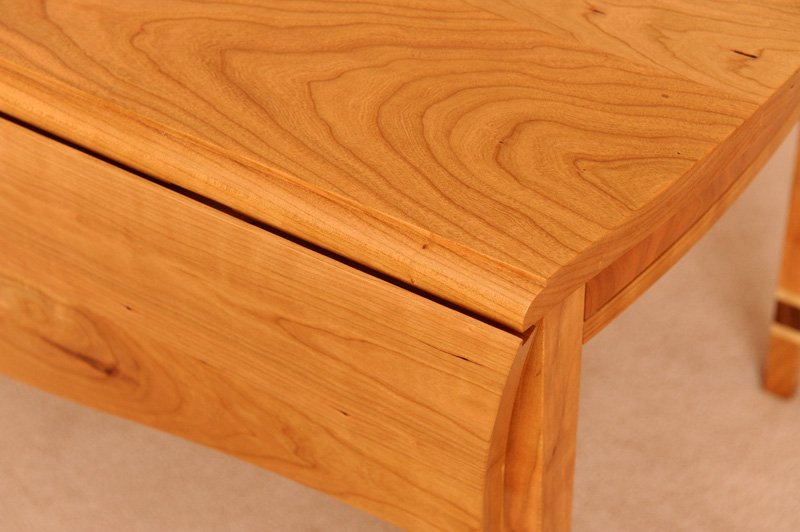
The joint between the table leaf and main top was calculated and simulated in AutoCAD to ensure smooth operation without scratching and no gaps when closed.
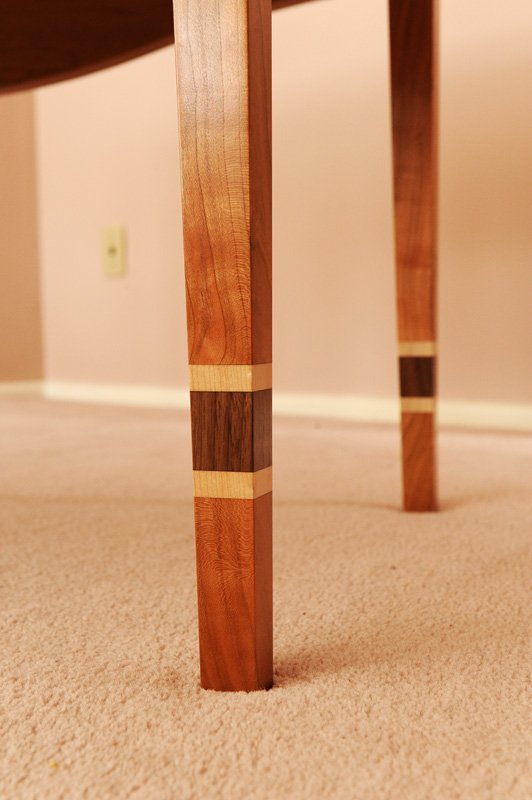
The rings on the legs are not inlays but maple and walnut parts laminated together, end grain to end grain, with a 3/4-inch diameter, 7-inch long oak dowel joining all the parts. Glued with epoxy for strength sufficient to handle regular use. Legs are laminated first, and then tappered, so it is very flush and no gap between different species.
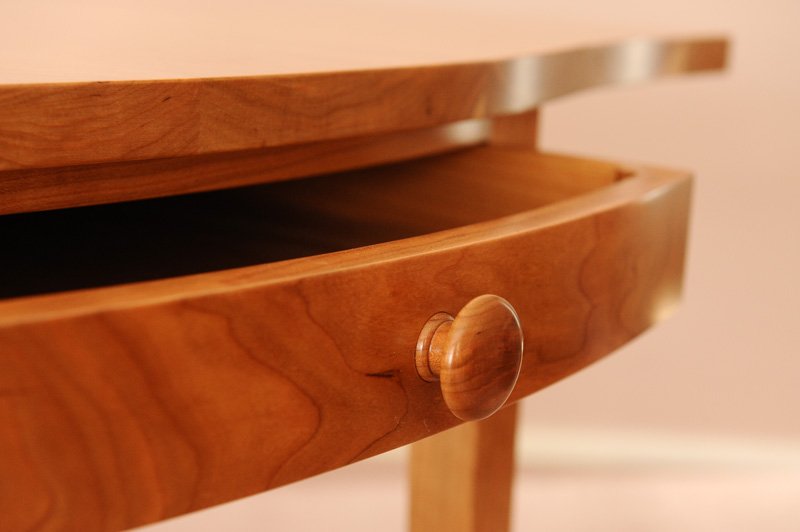
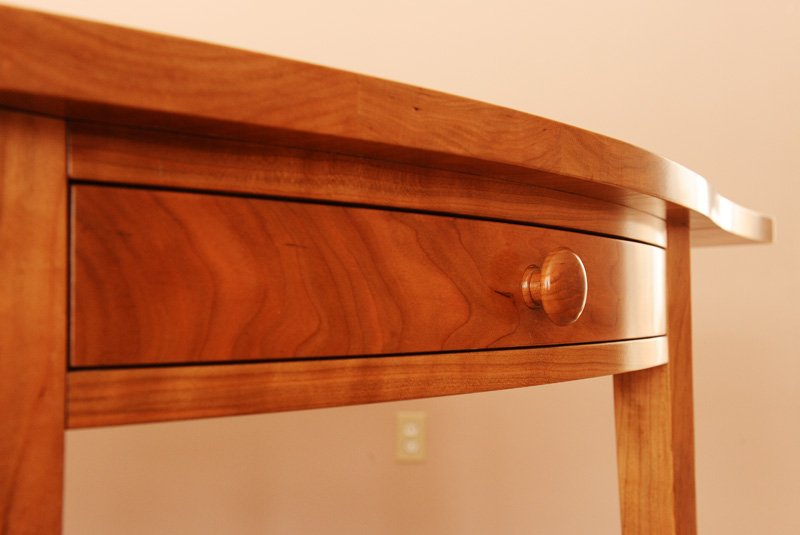
The drawers are a highlight of this piece. Solid sides and front, jointed with half blind dovetail.
The curved drawer front is formed from two pieces. One 1/2-inch thin piece and a 1-1/2-inch thick piece. The dovetails were cut on the thin piece first, then both pieces were glued together with adhesive applied 2 inches from each end. After drying, the curved shape was cut on the bandsaw and sanded smooth.
I don’t like the cut off at drawer back, and I don’t believe that screws can hold bottom for long time. So I cut groove on drawer box and insert the bottom in. Because the front is curved and irregular, it cannot be cut on a table saw. Instead, the dry-assembled drawer box was clamped with a band clamp and the groove was cut on a router table.
The drawer knobs were turned from leg offcuts. Turning two knobs back-to-back from one blank ensures they are perfectly matched.
To eliminate any gap between the knob and the curved drawer front, a cup hole was pre-drilled so the knob sits flush.
When drawer closed, the front is flush with stretchers, parallel with edge of table top. This level of precision is the hallmark of fine furniture.
The entire piece is finished with gloss clear lacquer — four coats on the body and five on the table top. The first two coats were sanded back almost completely to create an exceptionally smooth foundation.
Gallery